How to rotate server stations fairly
Every restaurant that rotates stations hears the same sentence: “I had the slow section again.” A fair method, and a record to back it up, takes most of the heat out of it.
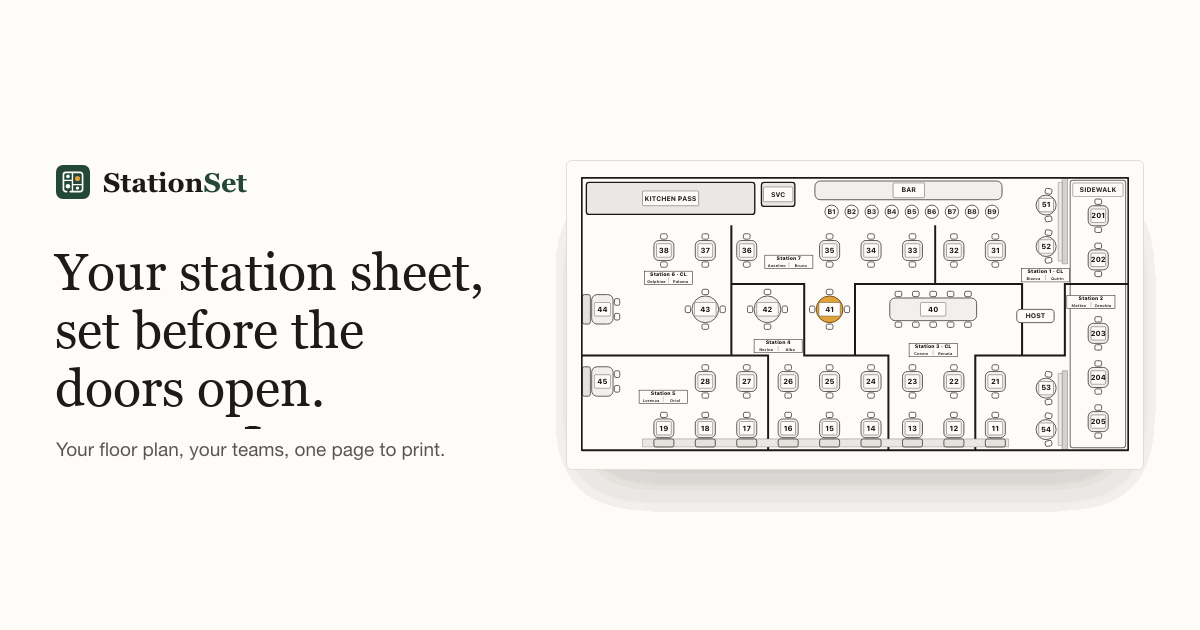
Why rotation causes arguments
Tables are not equal. Servers remember the slow Saturday much better than the three good ones around it, and without a record it is one person's memory against another's. The fix is not a cleverer shuffle. It is a clear rule and a record anyone can check.
Three common methods
- Move everyone one section each shift. Simple and easy to explain, but it ignores that some sections are worth much more than others.
- Seniority. Clear and easy to defend, but newer servers may rarely see the best sections.
- The manager decides. Flexible, and it works well when the manager keeps a record of who had what.
Any of these can work. What matters is that the rule is written down and applied the same way every week.
Give tables a value
Rate each table on a simple scale, for example from 2 for the weakest to 10 for the best. A section's value is the sum of its tables. Divide by the average section that day and you get a number around 1.00: above it is a stronger section, below it a weaker one.
Count busy days more
A weak section on a Saturday costs a server more than a weak section on a quiet Tuesday. Many managers count Friday and Saturday one and a half times when they look at how fair the weeks have been.
Keep a record
Write down who had which section on which day, and look at each server's average over the last several weeks. Servers whose average is well below 1.00 are the ones owed a better section. A record also shows when rotation is working, which is the best answer to a complaint.
Avoid repeats and protect closers
- Do not give a server the same tables two shifts in a row unless they ask for them.
- Lock the teams you want to keep together, then rotate the rest.
- Space out the closers so the same people are not always the last ones in the room.
A fair caution
A rotation method and a record help a manager explain decisions. They do not replace your company policy, and they cannot promise that nobody will complain. If a dispute turns into a formal complaint, follow your own policy and advice.